
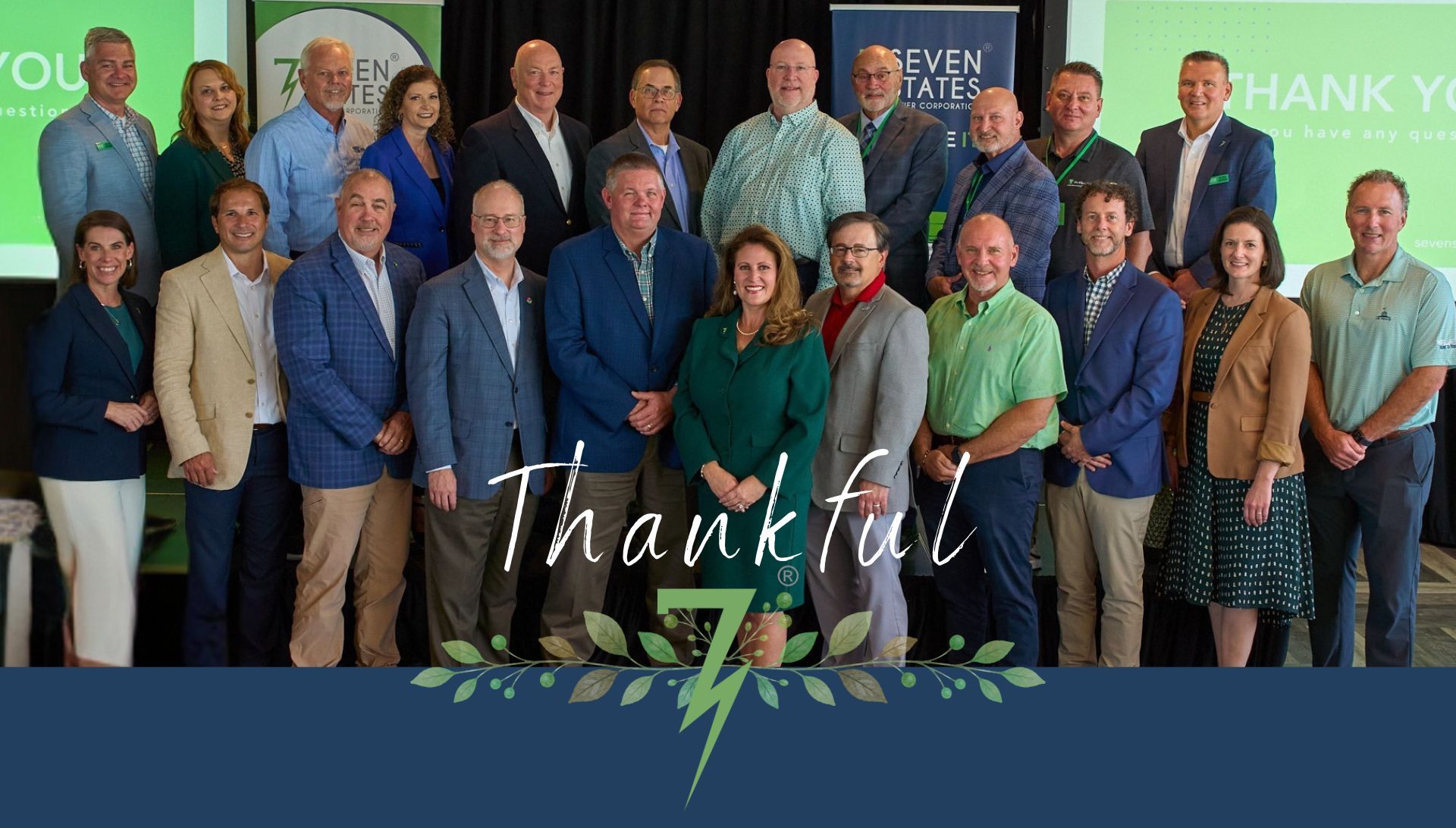
November gives us an opportunity to pause and reflect on the people and partnerships that help our communities thrive. At Seven States, we are especially grateful for those helping the Valley prepare for the energy it will need in the years ahead. Our work to finance power assets, expand energy production, and modernize the grid serves a purpose that reaches well beyond the infrastructure itself. Reliable, affordable electricity supports the schools where our children learn, the businesses that employ our neighbors, and the essential services our communities depend on every day. We share that responsibility with partners inside and outside the Valley who are committed to keeping electricity affordable and ensuring our region has the power it needs to support existing residential and commercial needs while attracting new economic opportunities. As part of our November Month of Thankfulness, we are recognizing the U.S. Department of Agriculture Rural Utilities Service (USDA RUS) for its collaboration in advancing innovative options for financing power assets in the Tennessee Valley. Through USDA’s New ERA program, Seven States was awarded approximately $439 million in funding, including a $415 million zero-interest loan and a $24 million grant. That investment supports the Energy Express Project, a 220-megawatt battery energy storage initiative being developed with Memphis Light, Gas and Water (MLGW), Nashville Electric Service (NES), and BrightRidge across Tennessee. We are thankful to the USDA RUS professionals whose expertise and collaboration have helped advance this investment, and to our local power company partners, Seven States team members, and advisors who have worked through the details required to bring it to our region. The path has required persistence and a willingness to adapt. Together, Seven States and USDA RUS navigated multiple hurdles. Working closely with USDA RUS and our local power company partners, we reshaped the Energy Express Project from its original concept into a battery storage project designed to meet local needs while aligning with federal priorities. The resulting design reflects the objectives of Seven States, the region, and USDA, and national industry initiatives. That collaboration continues to produce progress. Environmental clearance requirements have been met for all 17 proposed sites and five contingency sites. The request for proposals for a battery energy storage system provider closed November 13, 2026, and a selection decision is forthcoming. Groundbreaking is expected in 2027, with completion anticipated in 2028. Our relationship with USDA RUS has also opened a path to seek additional financing through its loan program, creating another option for financing generation assets in the Tennessee Valley. These efforts share a common goal: to leverage regional investments so more of the financial value of power assets stays in the Valley, benefiting the communities we serve. Strategic advocacy in Washington, D.C., and sustained conversations about the Valley’s energy needs have helped make these opportunities possible. We are grateful to the federal partners who have engaged with us and to the staff, advisors, and experts whose work has helped translate those conversations into progress. This Thanksgiving, we extend a warm “thank you” to our staff, USDA RUS, MLGW, NES, BrightRidge, LPC members, TVA partners, vendors, stakeholders, and friends of the organization for contributing to these efforts. Their commitment and collaboration are helping us make investments today that will serve our communities for years to come.
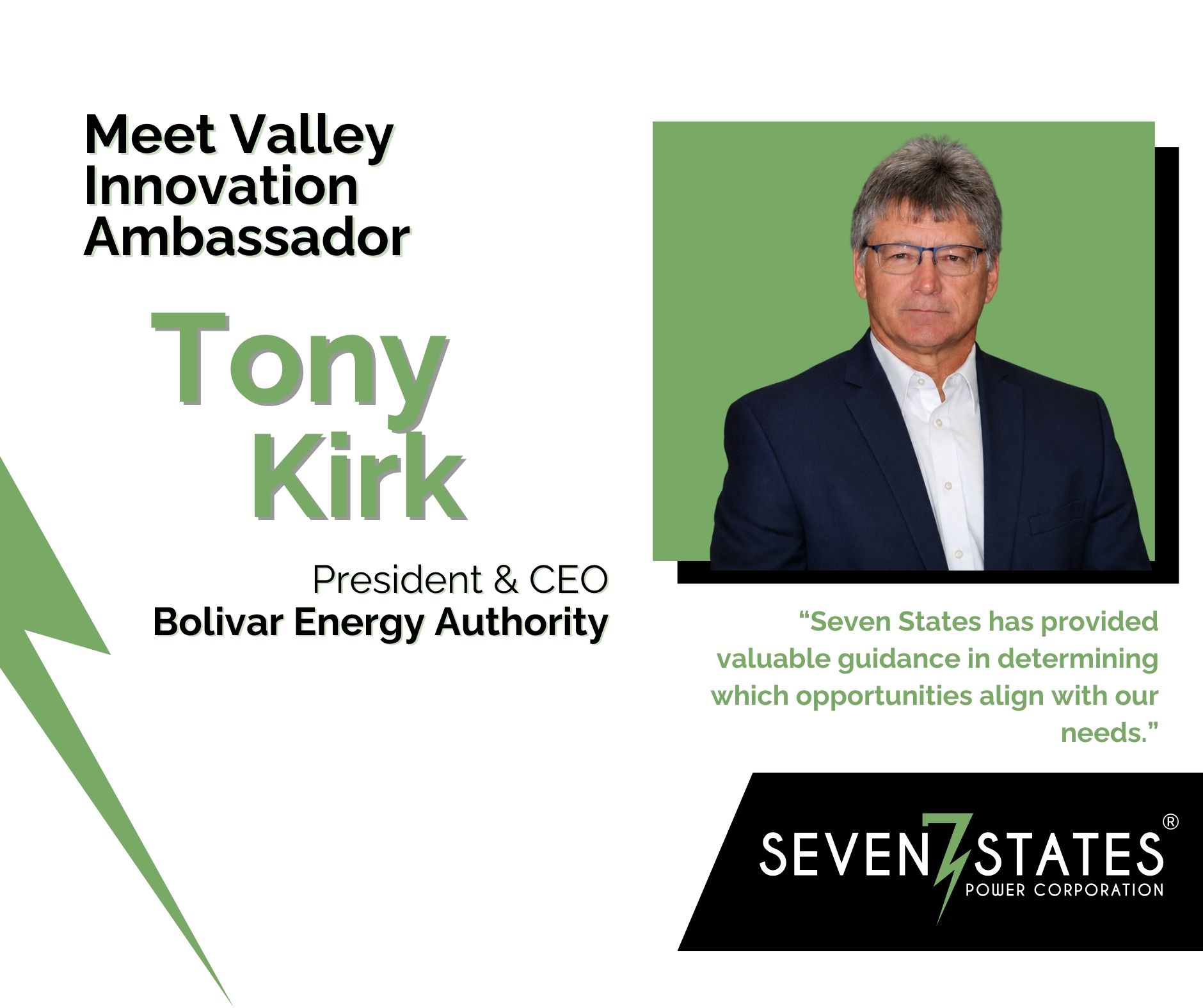
Bolivar Energy Authority’s President and CEO, Tony Kirk, understands the importance of looking ahead and investing in technology that strengthens communities and supports the Tennessee Valley’s continued growth. We asked him to share how his team is approaching modernization and building a stronger foundation for the future. Installing fiber throughout our entire system will allow us to partner with an Internet Service Provider (ISP) to deliver high-speed internet access to everyone we serve. Additionally, it will provide the infrastructure needed to connect all of our SCADA devices and substations to a reliable, high-speed fiber network. Fiber infrastructure will expand access to high-speed internet throughout our service area, providing our community with greater connectivity and improved access to reliable broadband services. There is inherent value in industry resources that enable local power companies to plan for the future and serve their communities, and Kirk sees Seven States as a trusted partner for BEA’s needs. Seven States has provided valuable guidance in helping BEA evaluate potential projects and determine which opportunities align with our needs and long-term goals, such as electric vehicle charging infrastructure. Despite the Valley’s numerous technological advancements, Kirk believes there is an aspect of the utility world that will always depend on extensive knowledge and experience. The lineman’s role will always require a hands-on approach, relying on traditional skills and fieldwork that technology can’t replace. To wrap up our conversation, we couldn’t resist one just-for-fun question for Kirk: If he could sit down to dinner with anyone, past or present, who would it be? I enjoy traveling and exploring our national parks. If I had to choose a favorite, I would probably say Theodore Roosevelt.
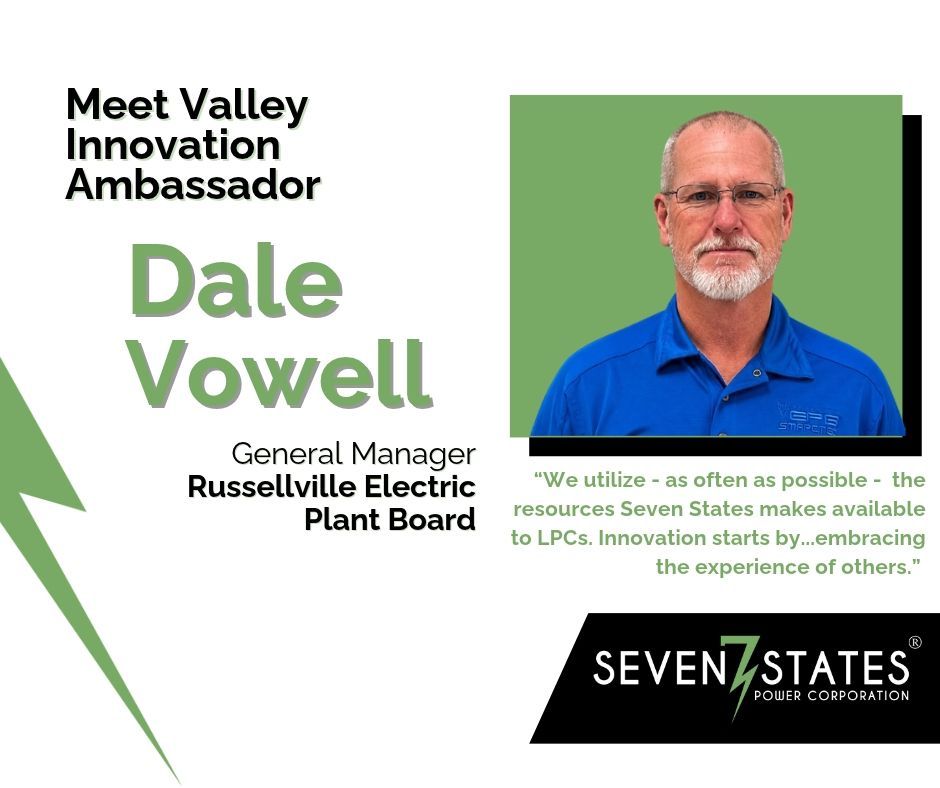
Dale Vowell, General Manager of Russellville Electric Plant Board, knows how vital it is to lead a culture of innovation and provide forward-thinking investments to help meet the changing needs of his community. His team has embraced technology and community partnerships to improve service and create new opportunities for their customers. We asked him to share how these efforts have made a difference and highlight some of the team’s accomplishments along the way. The COVID-19 pandemic highlighted the critical need for reliable, high-speed broadband, particularly in the rural areas of our county where access was limited or unavailable. By investing in our SmartNet fiber network and partnering with our county leaders and neighboring utilities, our Russellville EPB team helped extend broadband access to underserved areas throughout our county which expanded opportunities for students, families, businesses, and remote workers. While the primary focus was providing essential connectivity to more of our community, I personally felt the most impactful outcome was seeing organizations come together around that shared need. I was very proud of how our team and our local partners were so willing to provide the resources and manpower that bridged a digital divide. That was a great example of what can be accomplished with a common goal in mind. Another project we’re especially proud of is the early investment in our SmartNet fiber network. In 2006, Russellville EPB began offering wireless internet, and by 2011, we had expanded into high-speed fiber broadband and telephone services—positioning our community ahead of the curve in connectivity. Because we are community-owned, our utility recognized then the importance of investing in technology that would serve our customers not just today, but also in the future. That kind of forward-thinking investment continues to benefit our community and reflects our commitment to progress and the customers we serve. Vowell knows that innovation thrives on shared knowledge and fresh perspectives, and he sees Seven States as a valuable resource that helps local power companies stay informed, explore new opportunities, and bring valuable ideas back to their communities. Russellville EPB recognizes and utilizes – as often as possible – the informational resources Seven States makes available for LPCs. We always try our best to stay informed about advancements across the TVA region and evaluate any opportunities that might benefit our utility and the community we serve. Innovation starts with staying curious and by embracing the experiences of others. As technology continues to transform the utility industry, there are some aspects that simply cannot be replaced. Vowell shared that the knowledge and hands-on expertise of an LPC’s frontlines are paramount to keeping communities powered. Lineman ingenuity is something that will never be replaced. Having worked in this industry for many years, including a large part of that time as a lineman myself, I’ve seen firsthand how experience and thinking outside the box can make all the difference. It’s been amazing to watch linemen come up with creative solutions and even build their own tools or “gadgets” to get difficult jobs done safely and efficiently. As we’ve all experienced in these past few years, technology is not going to stop evolving, but the kind of hands-on problem-solving, creativity, and craftsmanship that I’ve witnessed linemen demonstrate over the years just can’t be replicated. Stepping away from the day-to-day of the utility industry, we couldn’t resist asking Vowell one more personal question: Who would be his dream dinner guest? I’d have to pick John Wayne – “The Duke”!