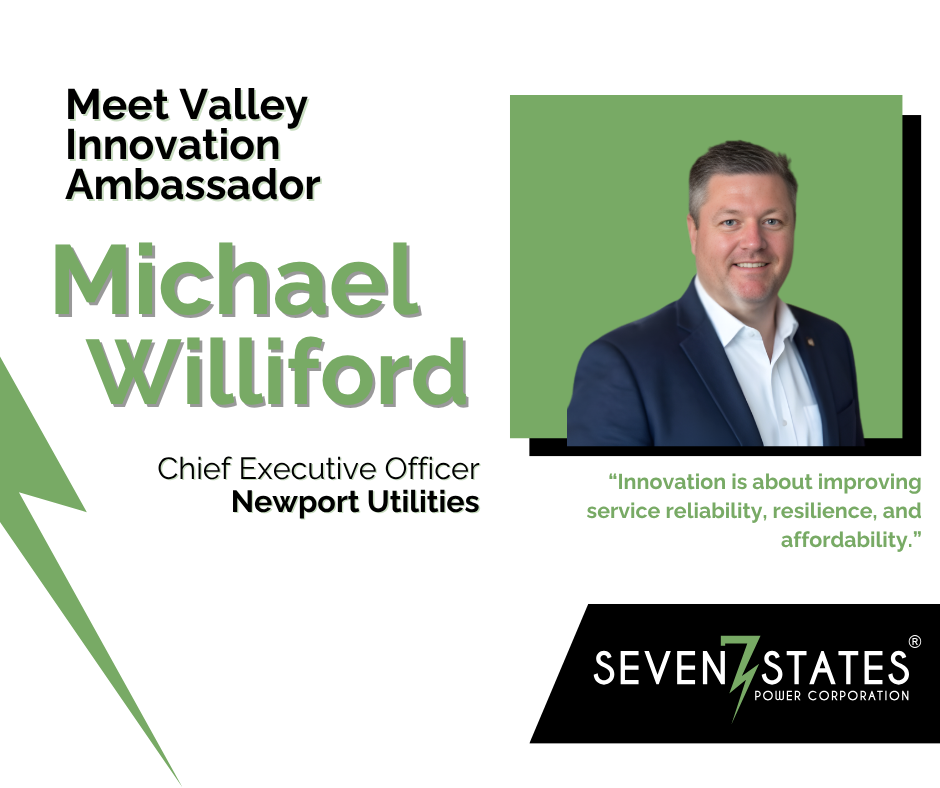
Since taking the helm as CEO, Michael has been instrumental in delivering innovative processes and technologies that are ensuring a reliable energy future for the more than 25,000 consumers served by Newport Utilities. Throughout his career, Michael has looked for opportunities to solve the most pressing needs within the energy sector. When asked about the most pressing needs for Newport Utilities, Michael stresses the need for reliability, visibility, and scalability. Solving for these needs translated into investments in grid hardening and automation, advanced metering infrastructure, SCADA modernization, and broadband expansion. Equally important was improving data integration across electric, water, wastewater, and broadband operations so they could move from reactive operations to predictive and preventative decision-making. Cybersecurity and resiliency—particularly for extreme weather events—were also critical priorities. While Seven States has not been directly engaged with Newport Utilities’ innovation initiatives, Michael recognizes that entities like Seven States are valuable when they can demonstrate the ability to align innovation with operational reliability, affordability, and long-term community value. When asked about what he would like for his customers to know about Newport Utilities’ role in bringing innovation forward he had this to say, “Innovation at Newport Utilities is not about technology for its own sake—it is about improving service reliability, resilience, and affordability while positioning the community for long-term economic growth. Our role is to be a careful steward of customer dollars while making forward-looking investments that reduce outages, improve response times, enhance transparency, and support businesses, schools, and public safety. When done correctly, most of this innovation is invisible to customers—but they experience it through fewer disruptions and better service.” Michael is excited about what the next five years holds for Newport Utilities. He is looking forward to expanded grid automation, advanced analytics driven by AMI and operational data, and deeper integration between electric, water, and broadband systems. Additionally, he believes battery storage, small-scale local energy production, and demand reduction programs will play an increasingly important role in enhancing reliability, lowering costs, and giving customers more control over their energy use. Ensure these technologies are deployed securely, cost-effectively, and in a way that maximizes community benefit while supporting economic development and long-term resilience is a priority. As for advice Michael would give to a new GM or CEO? Start with the problem, not the technology. Innovation should be tied directly to reliability, resilience, customer experience, or cost control. Build strong fundamentals first—governance, data quality, cybersecurity, and staff capability—before pursuing advanced solutions. Engage employees early, communicate clearly with customers and stakeholders, and be disciplined in measuring outcomes. Sustainable innovation is incremental, intentional, and aligned with the community’s long-term needs, not short-term trends.
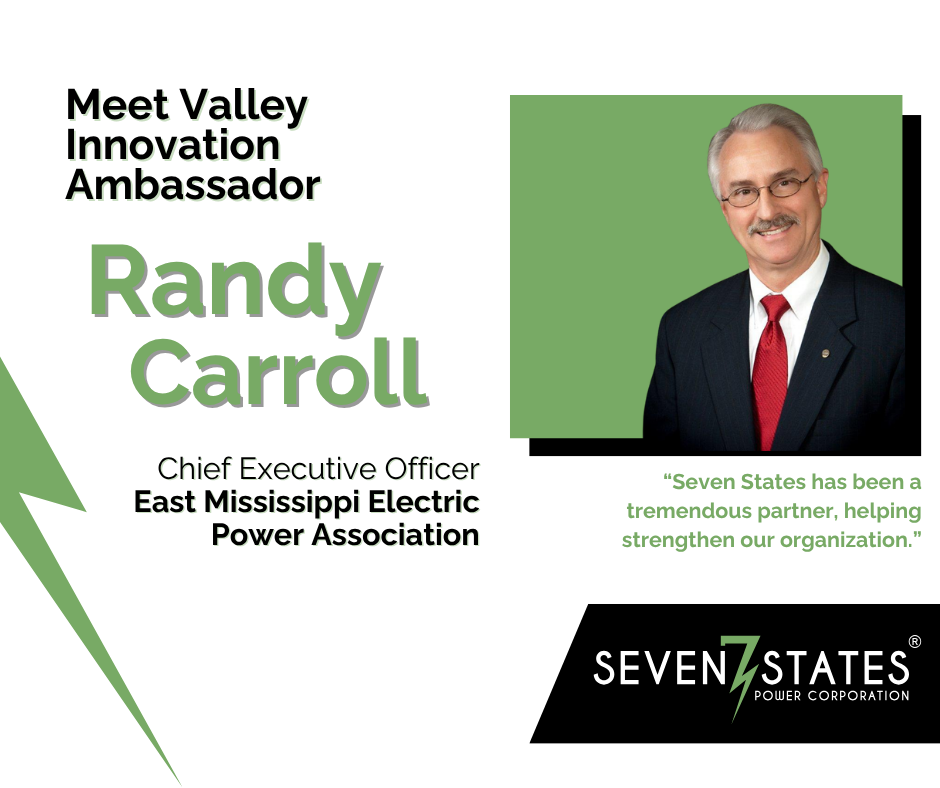
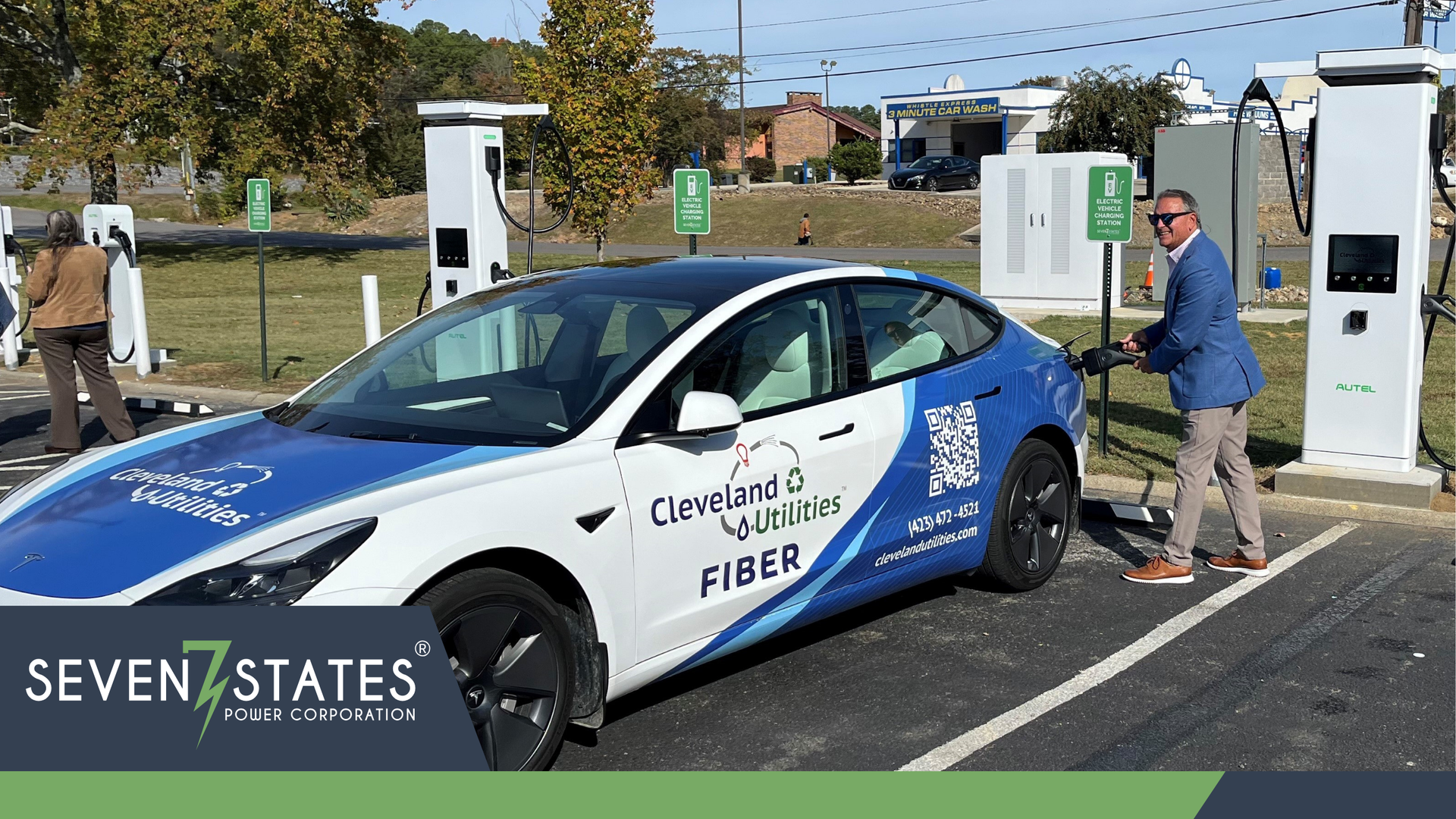
As Chief Executive Officer of East Mississippi Electric Power Association (EMEPA), Randy leads by embracing technology with a focus on how it enhances the lives of the members served by EMEPA. Over his 48 year career, Randy has moved teams through manual processes to personal computers, then to tablets, cell phones, and automated meter reading; each step significantly improving operational efficiency and service reliability. Randy has been an integral leader in completing 3,850 miles of fiber to serve nearly 17,000 subscribers. Moreover, EMEPA also helped facilitate the installation of full backup generation at NAS Meridian and assisted in deploying solar generation paired with microgrid technology at the base. These efforts strengthened energy security and resilience for critical infrastructure in our community. When asked about how Seven States has specifically helped support innovation in the EMEPA footprint Randy said, “Seven States has been a tremendous partner by providing the technical knowledge, strategic guidance, and support necessary to bring these complex projects to life. Their expertise helped us evaluate opportunities, mitigate risk, and execute effectively, particularly in areas such as broadband expansion, backup generation, and microgrid deployment. Innovation requires both vision and competence, and Seven States has helped strengthen both within our organization.” In a time of rapid introduction and adoption of innovation, Randy explains how EMEPA approaching ongoing implementation. “I want our members to understand that implementing new technology is never done simply for the sake of technology. Every advancement we pursue is focused on making their service more reliable, sustainable, and resilient. Whether it is automated metering, fiber broadband, or microgrid support for critical facilities, our goal is always to improve the lives of the people we serve.” As EMEPA looks ahead, they will explore how artificial intelligence enhances their operations and all the ways it will be used over the next five years to increase productivity, develop innovative solutions, and communicate more efficiently with their members. As for advice Randy would give to a new GM or CEO? “You often cannot fully understand the usefulness of a technology until you implement it and allow good employees to work with it. Innovation requires trust in your people and trust in the process. If you hire capable, mission-driven employees and give them the tools and freedom to explore new solutions, they will often exceed your expectations.”
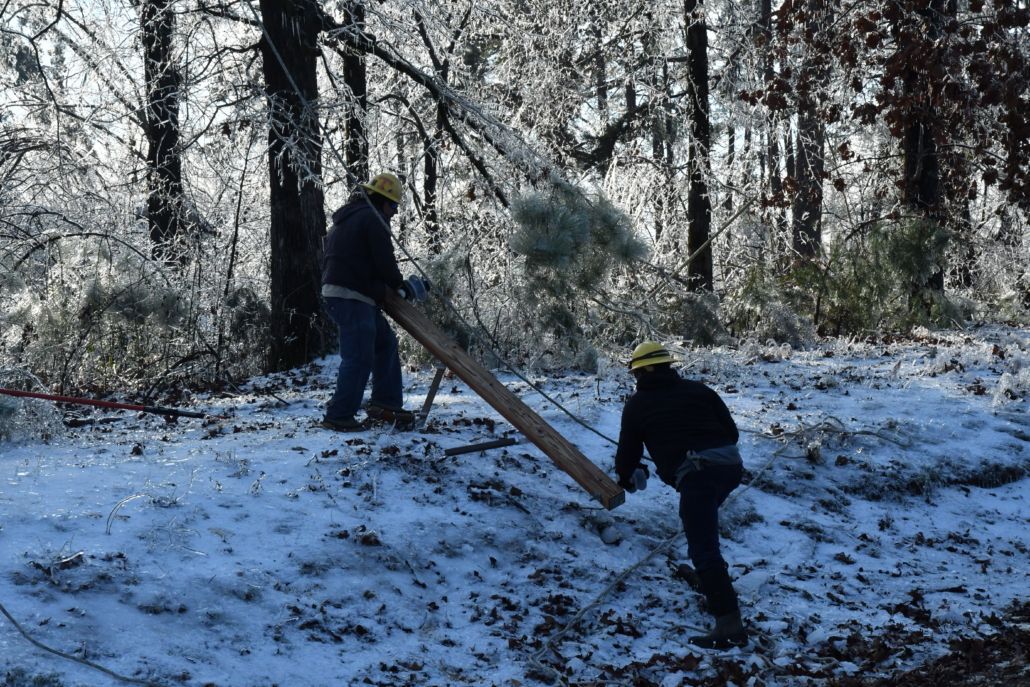
It’s easy to forget that the excitement of a potential “snow day” is not shared by everyone. Winter storms are felt differently depending on where you stand. When news of Winter Storm Fern first began to circulate, many of us debated whether it would amount to much at all—whether we’d “actually get any snow,” or whether the warnings would quietly fade away. For our local power companies (LPCs), though, there is no room for debate. Preparation begins long before the first snowflake falls. Crews mobilize. Capacity is recruited. Logistics are coordinated—meals, lodging, equipment—on the assumption that the storm will come, and that its impact could be catastrophic for the communities they serve. As Winter Storm Fern made her way across the Tennessee Valley, what unfolded in the weeks that followed was nothing short of remarkable. The storm itself was a spectacle – both terrifying and beautiful. In its aftermath, we saw images of deep snowbanks, children sledding, and intricate ice formations clinging to trees and fences. But those of us in the energy industry understand the other side of that beauty—the weight of ice on lines, the strain on equipment, and the fragile balance that keeps electricity flowing. Once again, we were reminded that society moves at the pace of electricity. In the days after the storm passed, we witnessed something even more powerful than the weather itself: the best of our humanity. The people we are proud to work alongside woke up day after day, coffee in hand and hot stick over their shoulder, ready to face whatever challenge waited beyond the truck door—all so that power, and a sense of order, could be restored. Was the work harder than expected? Probably. Did it reaffirm what it means to put service above self? Without question. While many of us remained sheltered at home, LPC crews from across the Valley stepped up. They melted the storm inch by inch, knocking ice from lines and equipment so electricity could move again without the crushing weight pulling it back down. They followed the sound of silence, tracing outages through snow-buried lines until they found a snapped conductor lying quiet in a ditch. Bucket trucks crept through ice-locked streets, their booms lifting linemen into sleet-soaked darkness to replace shattered crossarms and transformers split by the cold. The grid returned not all at once, but by touch—each repaired connection passed hand to hand through crews spread across miles of frozen ground. As Mike Partin, President of the National Rural Electric Cooperative Association (NRECA) and President & CEO of Sequachee Valley Electric Coop, recently shared, “It’s more than a principle on paper—it’s a promise we live out when disaster strikes. These men and women leave their own families to help other families. They go wherever they’re needed, whenever they’re needed, without hesitation.” And they were not alone. Businesses across the region stepped in as well, delivering hot meals—Taco Bell, Chick-fil-A, the unmistakable fuel of long days and longer nights. Electricity and kindness—two commodities that can feel in short supply—were both restored through collective effort. Moments like these force us to pause and reflect on the grit, resilience, and stamina that make our communities strong. Sometimes, Mother Nature reminds us not only of our vulnerabilities, but of our better angels. Today, homes are warm. Restaurants are open. Kids are back in school. Life has returned to something resembling normalcy—because of the unity, sacrifice, and hard work of LPCs across the Tennessee Valley. So we wanted to take a moment to simply say: Thank you.